
"Come back when you have 20% down." It is the single most common piece of advice given to first-time buyers, and for most people in Ontario it is wrong. It keeps renters renting for years longer than they need to, while prices and rent climb past them.
You do not need 20% down to buy a home in Ontario. Here is what you actually need, what the trade-off really costs, and when 20% is genuinely the better move.
What is the minimum down payment in Ontario?
The minimum down payment in Ontario is 5% on the first $500,000 of the purchase price, then 10% on any portion between $500,000 and $1,500,000, and 20% only on homes priced at $1,500,000 or more. So for the vast majority of first-time purchases, the legal minimum is far below 20%.
5% versus 20% down, by home price (Ontario, 2026)
- $400,000. Minimum down (5% tier): $20,000; 20% down: $80,000; Difference: $60,000
- $600,000. Minimum down (5% tier): $35,000; 20% down: $120,000; Difference: $85,000
- $800,000. Minimum down (5% tier): $55,000; 20% down: $160,000; Difference: $105,000
Source: Government of Canada down payment rules. Above $500,000 the minimum is 5% of the first $500,000 plus 10% of the remainder.
The difference is not small. On a $600,000 home, waiting for 20% means saving an extra $85,000. At $1,500 a month of savings, that is nearly five more years of renting.
Where did the 20% rule come from?
The 20% figure is not a legal requirement. It comes from one specific fact: if you put down 20% or more, you do not have to pay mortgage default insurance. That is the entire origin of the myth. Somewhere along the way "20% avoids insurance" became "20% is required," and a helpful threshold turned into a barrier that stops people from buying at all.
What is mortgage default insurance and what does it cost?
If you put down less than 20%, your lender requires mortgage default insurance, usually through CMHC. It protects the lender if you stop paying. You pay a one-time premium, but here is the part most people miss: the premium is added to your mortgage, not paid in cash at closing.
The premium is a percentage of your mortgage, based on how much you put down.
CMHC mortgage default insurance premium rates
- 5% to 9.99%. Premium (% of mortgage): 4.00%
- 10% to 14.99%. Premium (% of mortgage): 3.10%
- 15% to 19.99%. Premium (% of mortgage): 2.80%
- 20% or more. Premium (% of mortgage): None
Source: CMHC premium rates, 2026. In Ontario, 8% PST on the premium is payable in cash at closing.
Take that $600,000 home with 5% down. The mortgage is $570,000, and the premium at 4.00% is about $22,800, added to the loan. The only part you pay in cash is the Ontario PST on the premium, roughly $1,824. So the real out-of-pocket cost of putting 5% down instead of 20% is the PST plus a slightly higher monthly payment, not a wall of cash.
the cash cost of default insurance on a $600,000 home with 5% down, the rest is financed
The real cost of waiting to save 20%
The question is never just "insurance or no insurance." It is "buy now with insurance, or wait years to avoid it." And waiting has its own price tag that nobody puts on the invoice:
- Rent you keep paying. Two extra years of $2,500 rent is $60,000 gone, building someone else's equity.
- Prices that may keep rising. If your target home appreciates while you save, the 20% you are chasing becomes a moving target on a bigger number.
- Lost equity and mortgage paydown. Every month you own, part of your payment builds your equity instead of your landlord's.
For many buyers, the insurance premium is smaller than the cost of one more year of waiting. That is the math the "come back with 20%" advice ignores.
When does 20% down actually make sense?
To be fair, 20% is genuinely better in specific situations. Put 20% down if:
- You already have the cash without draining your emergency fund or delaying the purchase for years.
- You want to avoid the insurance premium and the small monthly cost of financing it.
- You want lower monthly payments and more breathing room in your budget.
- You are buying at $1.5M or more, where 20% is the legal minimum anyway.
The rule is simple: if you have 20% comfortably, use it. If reaching 20% means years of waiting, do not let it stop you from buying with 5%.
How the Down Payment Boost helps either way
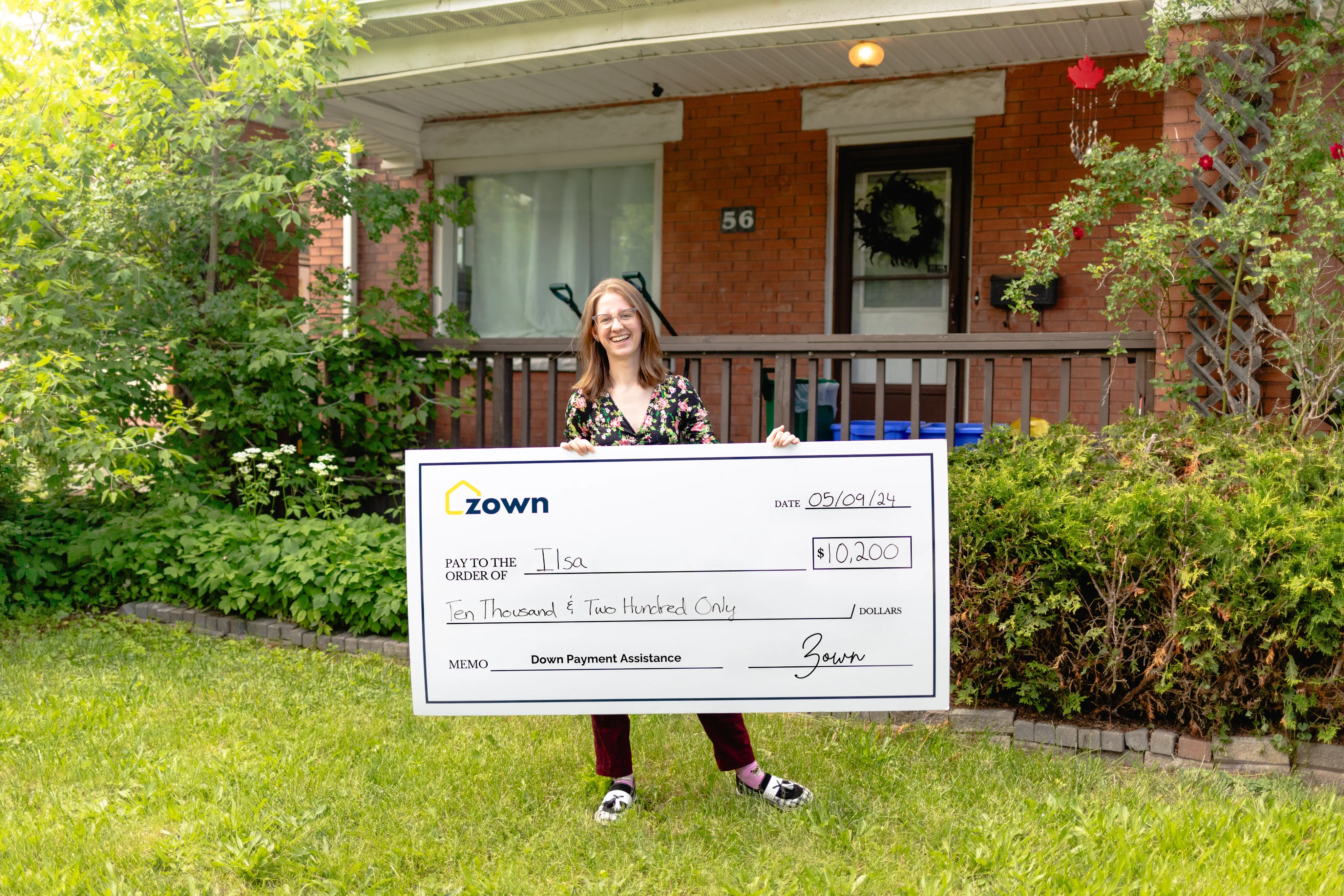
Whether you put down 5% or more, the cash you need on closing day is what actually gates the purchase. Zown's Down Payment Boost gives eligible Ontario buyers 1% of the price back (up to $25,000), whichever mortgage provider they use, paid at closing with a Zown partner lawyer (2 to 8 weeks otherwise). It offsets your closing costs and lowers the total cash you need to have saved, which is exactly the number that keeps first-time buyers on the sidelines.
See how much you could get back →
Last updated July 27, 2026. General information, not financial advice. Insurance premiums and rules can change; confirm current figures with your lender.