Short answer: no, you usually should not max out your pre-approval. The amount you are approved for is a ceiling, not a target. It tells you the most a lender is willing to offer, not the price that leaves you comfortable month to month. Most buyers are happier, and safer, buying below that number.
Here is the difference between the approval amount and a budget you can actually live with, and how to set the second one.
What does maxing out my pre-approval actually mean?
A pre-approval is a lender's estimate of the largest mortgage they will give you based on your income, debts, and the current stress-test rate. It is a maximum, not a recommendation.
Maxing it out means buying a home priced at or near that top number. The trouble is that a lender's model only looks at whether you can technically make the payment. It does not know your car repairs, your daycare costs, your travel, or how much you want left over at the end of the month.
That gap, between what you are approved for and what feels comfortable, is where the phrase "house-poor" comes from. You own the home, but the payment eats so much of your income that everything else feels tight.
Approval amount vs. comfortable budget: what's the difference?
Think of them as two different numbers with two different jobs.
The approval amount answers: "What is the most I could borrow?" It is built to the edge of what your income can support on paper.
Your comfortable budget answers: "What payment can I carry while still saving, handling surprises, and enjoying life?" That number is almost always lower, and it is the one that should drive your search.
a common guideline for housing costs as a share of gross monthly income; many buyers feel more comfortable well below their approved maximum
A widely used rule of thumb is to keep total housing costs (mortgage, property tax, heat, and condo fees if any) under roughly a third of your gross income. Lenders will often approve you for more than that. The rule of thumb is closer to comfortable; the approval is closer to the edge.
What does maxing out do to my monthly costs?
Buying at the top of your approval raises more than your mortgage payment. It scales up almost every recurring cost tied to the home:
- Property taxes rise with the value of the home.
- Heating, hydro, and utilities tend to be higher in a larger or pricier property.
- Condo or maintenance fees climb with the unit.
- Insurance goes up with the replacement cost.
- Repairs and upkeep are usually estimated as a percentage of the home's value, so a bigger home means bigger surprises.
None of these show up cleanly in a pre-approval. So the real monthly cost of a maxed-out purchase is often higher than the mortgage figure that made the number look affordable.
If you put less than 20% down, remember that mortgage default insurance is required and its premium is added to your mortgage, which nudges the payment up again. That is worth planning for before you stretch to the top of your range. Our guide on how much down payment you actually need walks through where that line sits.
What about my emergency buffer?
This is the part buyers regret skipping. When you spend to the ceiling, two things usually happen at once: your monthly payment is at its highest, and your savings are at their lowest because you put more into the purchase.
That combination is fragile. A job change, a leaky roof, or a rate increase at renewal can turn a tight budget into a stressful one fast.
A healthier approach is to leave room on both sides: a payment you can carry without white-knuckling it, and cash set aside after closing. Many buyers aim to keep several months of expenses in reserve once the keys are in hand.
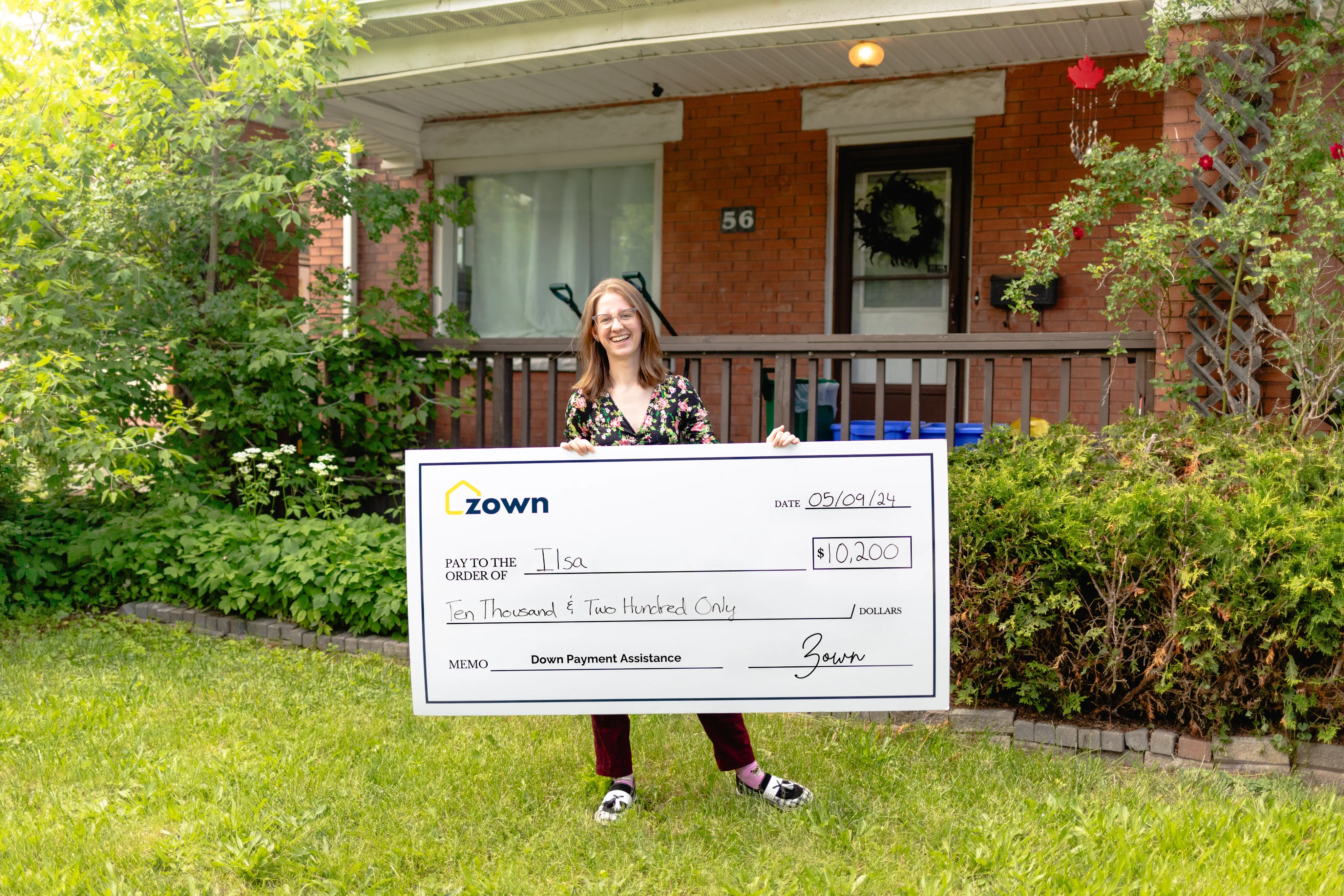
This is also why how you use any cash back at closing matters. Zown's Down Payment Boost pays cash back of 1% of the purchase price, to a maximum of $25,000, into your savings at closing. On an $800,000 home that is roughly $8,000. Most buyers put it toward closing costs and post-closing expenses like furniture or moving, which is exactly the kind of buffer that a maxed-out purchase leaves no room for.
What is rate-renewal risk, and why does it matter here?
Most Canadian mortgages are not locked in for the full amortization. Your rate is fixed for a term, often a few years, and then you renew at whatever rates exist at that time.
If you bought at the very top of your budget at a low rate, a higher rate at renewal can push your payment up sharply, because you have little slack to absorb it. If you bought below your ceiling, the same rate increase is easier to swallow.
You cannot control where rates go. You can control how much room you leave yourself. Buying below the maximum is one of the simplest ways to protect against a renewal shock.
Max budget vs. comfortable budget: the trade-offs
Buying at your ceiling vs. buying to a comfortable payment
- Monthly payment. Maxed-out purchase: At the top of what your income allows; Comfortable budget: Leaves breathing room each month
- Emergency savings after closing. Maxed-out purchase: Often minimal; Comfortable budget: Cushion kept in reserve
- Renewal rate increase. Maxed-out purchase: Hard to absorb; Comfortable budget: Easier to absorb
- Unexpected costs (repairs, life changes). Maxed-out purchase: Stressful; Comfortable budget: Manageable
- Ability to keep investing (FHSA, RRSP, etc.). Maxed-out purchase: Squeezed; Comfortable budget: Protected
- Day-to-day lifestyle. Maxed-out purchase: Tight; Comfortable budget: Flexible
Source: Zown Realty, Ontario 2026
The maxed-out column is not impossible to live in. But it removes your margin for error, and buying a home is exactly the moment you want margin.
So how do I set a comfortable budget instead?
Work backward from a payment, not up to a price.
- Decide on a total monthly housing cost you would feel good about, ideally below the top of the guideline range, not at it.
- Subtract realistic property tax, utilities, insurance, and any condo fees.
- What is left is your comfortable mortgage payment. Use that to find your price ceiling, then shop below it.
- Keep contributing to savings and registered accounts through the process, so buying does not wipe out your financial cushion.
Because Zown agents are salaried rather than paid on commission, the advice you get is not tied to a bigger sale price. We would rather see you buy a home you are comfortable in than the most expensive one a lender will allow. If you are early in the process, our first-time home buyer guide for Ontario covers the full path from savings to closing.
Will maxing out get my offer accepted faster?
No. What strengthens an offer is a solid deposit, clean terms, and financing you can actually close on, not spending every dollar you were approved for. Overextending to win a home can leave you stretched the moment you move in. See how to get pre-approved for what lenders look at.
How do FHSA and RRSP savings fit in?
They help you buy without draining everything. A First Home Savings Account lets you contribute up to $8,000 a year, and the RRSP Home Buyers' Plan lets you withdraw up to $60,000, repaid over time. Using these can fund a purchase while keeping some cash in reserve, which is exactly what a maxed-out budget tends to erase.
What if the home I want is above my comfortable budget?
Then it is worth a rethink rather than a stretch. You could adjust the neighbourhood, the size, or the timing, and let cash back at closing and first-time buyer rebates ease the gap. A salaried Zown agent can help you find a home that fits your numbers instead of testing their limit.
See what your Down Payment Boost adds up to →
Last updated July 21, 2026. General information, not legal or financial advice.