Buying your first home in Ontario feels like standing at the bottom of a mountain with no map. There are down payment rules, a stress test, three different government programs, closing costs nobody warned you about, and a market that moves faster than your savings account.
This guide is the map. It walks through every step in the order you will actually face it, with the real Ontario numbers for 2026 and the programs that put money back in your pocket. It is written by licensed Zown realtors who close these deals every week, and reviewed for accuracy by our head of account management.
What do you need to buy your first home in Ontario?
To buy your first home in Ontario in 2026 you need three things: a down payment of at least 5% (more above $500,000), enough income to pass the mortgage stress test, and cash for closing costs of roughly 1.5% to 4% of the price. First-time buyers also get access to tax-sheltered savings accounts and rebates that reduce what you need out of pocket.
The rest of this guide breaks each of those down. Here is the journey at a glance.
The 8 stages of buying your first home in Ontario
- 1. Check readiness. What happens: Review savings, credit, and debt; Typical timing: Start here
- 2. Get pre-qualified. What happens: Confirm your real budget; Typical timing: 1 day
- 3. Save the down payment. What happens: Use FHSA, HBP, and a Boost; Typical timing: Ongoing
- 4. Understand the costs. What happens: Down payment plus closing costs; Typical timing: Before you shop
- 5. Search and view. What happens: AI search plus showings; Typical timing: 2 to 8 weeks
- 6. Make an offer. What happens: Agreement of Purchase and Sale; Typical timing: 1 day per offer
- 7. Conditions. What happens: Financing, inspection, status certificate; Typical timing: 5 business days
- 8. Close. What happens: Lawyer, keys, move in; Typical timing: 30 to 90 days
Source: Zown Realty, Ontario 2026
How much down payment do you need in Ontario?
The minimum down payment in Ontario follows federal rules based on the purchase price. You do not need 20% to buy. The tiers are:
- 5% on homes priced at $500,000 or less.
- 5% on the first $500,000, then 10% on the portion between $500,000 and $1,500,000.
- 20% on homes priced at $1,500,000 or more.
Here is what that means in dollars for common Ontario price points.
Minimum down payment by home price (Ontario, 2026)
- $500,000. Minimum down payment: $25,000; Effective percentage: 5.0%
- $600,000. Minimum down payment: $35,000; Effective percentage: 5.8%
- $700,000. Minimum down payment: $45,000; Effective percentage: 6.4%
- $800,000. Minimum down payment: $55,000; Effective percentage: 6.9%
- $1,000,000. Minimum down payment: $75,000; Effective percentage: 7.5%
- $1,500,000. Minimum down payment: $125,000; Effective percentage: 8.3%
Source: Government of Canada minimum down payment rules, in effect since December 15, 2024
If you put down less than 20%, you pay mortgage default insurance (usually from CMHC). It protects the lender, not you, and it is added to your mortgage. We cover exactly how it works, and why 20% is a myth for most first-time buyers, in Do You Really Need 20% Down?
the minimum down payment on an $800,000 home in Ontario, not $160,000
What government programs help first-time buyers?
Ontario first-time buyers can stack several programs. Used together, they can add tens of thousands of dollars to what you can put toward a home. The three that matter most in 2026:
- The First Home Savings Account (FHSA). Contribute up to $8,000 a year, to a $40,000 lifetime maximum. Contributions are tax-deductible like an RRSP, and withdrawals for a first home are tax-free like a TFSA. It is the single best account for most first-time buyers.
- The RRSP Home Buyers' Plan (HBP). Withdraw up to $60,000 from your RRSP tax-free for a first home, or up to $120,000 as a couple. You repay it to your RRSP over 15 years. You can use the FHSA and the HBP together.
- The Ontario Land Transfer Tax rebate. First-time buyers get a rebate of up to $4,000 on the provincial land transfer tax. If you buy in the City of Toronto, you also get a municipal rebate of up to $4,475.
A quick note on what is no longer available: the federal First-Time Home Buyer Incentive (the shared-equity program) stopped accepting applications in March 2024. If you see it recommended in older articles, it is gone.
For the full breakdown of every option, including private ones like Zown's Down Payment Boost, see Down Payment Assistance in Ontario.
Can you afford it? The stress test and your real budget
Your budget is not the maximum a lender approves you for. In Canada, every insured mortgage has to pass a stress test: you must qualify at the higher of your contract rate plus 2%, or 5.25%. This is the government making sure you can still pay if rates rise.
Two numbers set your approval:
- Gross Debt Service (GDS) ratio: housing costs (mortgage, property tax, heat, half of condo fees) should be around 39% of your gross income or less.
- Total Debt Service (TDS) ratio: all debt payments including the above should be around 44% or less.
The honest advice we give every buyer: qualifying for the maximum and buying at the maximum are different decisions, and the gap between them is where a lot of first-time buyers overextend.
The fastest way to find your real number is a pre-qualification. Zown's takes a few minutes and does not affect your credit score, because it runs through our Equifax partnership as a soft check.
See what you can actually afford →
What are the hidden costs of buying a home?
The down payment is the number everyone plans for. Closing costs are the number that surprises people. Budget 1.5% to 4% of the purchase price for costs that are due on closing day, separate from your down payment.
Typical closing costs on an $800,000 Ontario home
- Land transfer tax (provincial). Estimate: $12,475; Notes: Before first-time buyer rebate of up to $4,000
- Legal fees and disbursements. Estimate: $1,800 to $2,500; Notes: Your real estate lawyer
- Title insurance. Estimate: $250 to $500; Notes: One-time
- Home inspection. Estimate: $400 to $600; Notes: Optional but recommended
- PST on CMHC premium. Estimate: Varies; Notes: 8% of the insurance premium, if you put under 20% down
- Adjustments. Estimate: Varies; Notes: Prepaid property tax or utilities you reimburse the seller
Source: Zown Realty estimates, Ontario 2026. Toronto buyers pay a second municipal land transfer tax.
The most under-explained number in the whole process is the total cash you actually need on closing day: down payment plus closing costs, minus rebates, minus any Down Payment Boost. That single figure is what decides whether you can buy this year or next.
How does Zown's Down Payment Boost change the math?
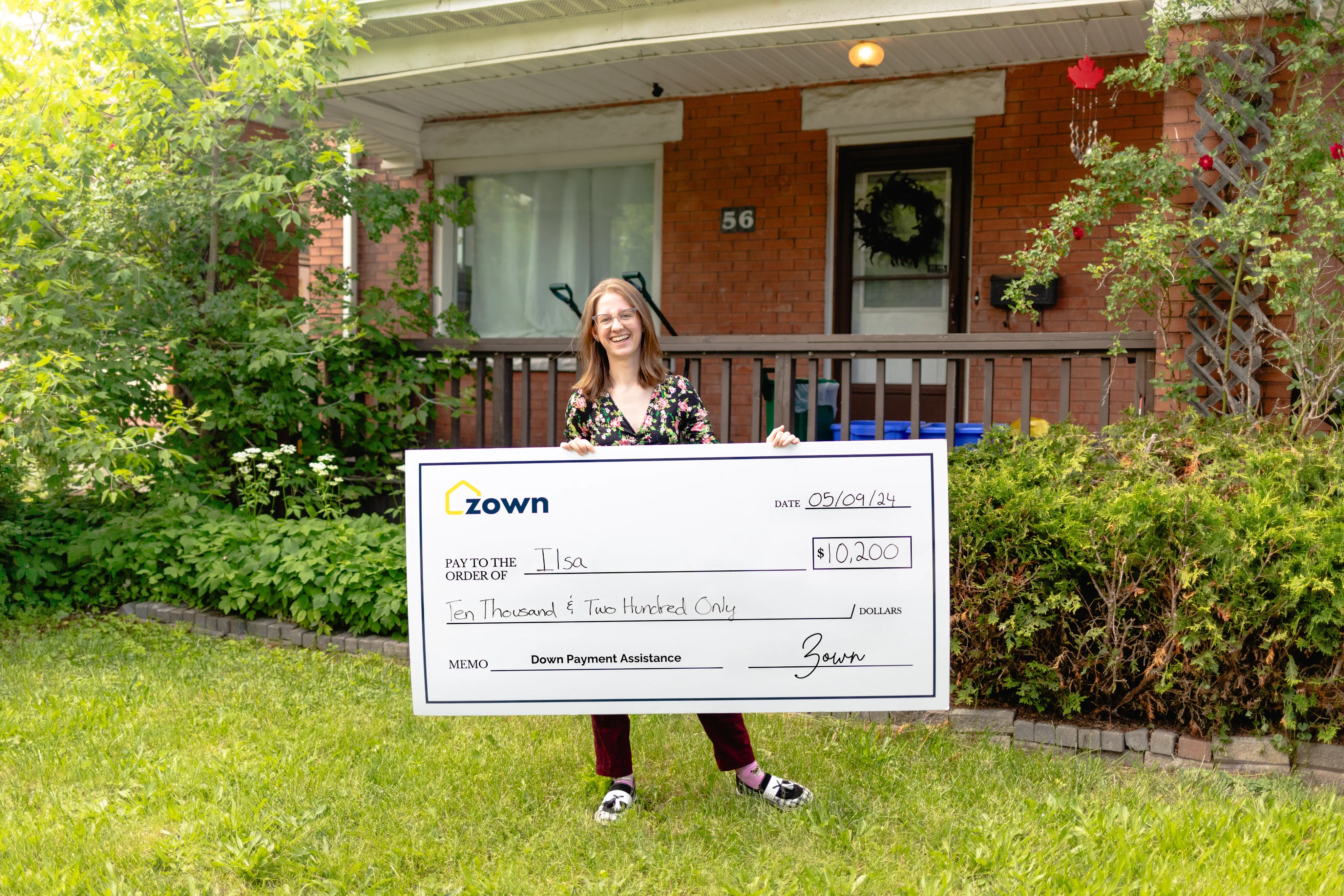
Zown is a brokerage that gives buyers a large share of the commission it earns, upfront. Eligible buyers get a Down Payment Boost of 1% of the purchase price, up to $25,000, paid as cash at closing.
Because it arrives at closing, the Boost works as extra savings in your pocket. It helps cover your closing costs and the many expenses that hit right after you get the keys, and it lowers the total amount of cash you need to have saved to buy. On an $800,000 home, that is up to $8,000 back.
in Down Payment Boosts Zown has given to first-time buyers so far
This is why the order of operations matters. You save with the FHSA and HBP, you claim the land transfer tax rebate, and the Boost offsets the closing-day cash. Stacked together, they can move your purchase date up by many months.
The home buying timeline: what happens and when
Here is the realistic timeline for a first purchase in Ontario, from decision to keys.
- Pre-qualification (day one). Confirm your budget with a soft credit check. This tells you your price range and makes your offers credible.
- Search and showings (2 to 8 weeks). With Zown, AI matching narrows the list to homes that fit your real budget and lifestyle, and you can book showings on demand rather than waiting on one agent's calendar.
- Offer (1 day). When you find the home, you submit an Agreement of Purchase and Sale. We cover this in detail in How to Make an Offer on a House in Ontario.
- Conditions (about 5 business days). You finalize financing, get a home inspection, and for a condo, review the status certificate.
- Closing (30 to 90 days after acceptance). Your lawyer handles title, the mortgage funds, and you get the keys.
Most first-time buyers move through this in three to six months once they start seriously looking.
Do you need a realtor to buy your first home?
You can technically buy without a realtor, but for a first purchase in Ontario it is rarely a good idea. A buyer's agent reviews the Agreement of Purchase and Sale, spots problems in a status certificate, reads sold comparables so you do not overpay, and negotiates on your behalf. In Ontario, the seller typically pays the commission, so buyer representation usually costs you nothing directly.
The real question is which realtor, and how they are paid. We break that down in What Is a Cashback Realtor?
Your next step
You do not have to solve the whole mountain at once. Start with one number: what you can actually afford. It takes a few minutes, it does not touch your credit, and it turns a vague dream into a real plan.
Get your personalized Down Payment Boost estimate →
Last updated July 21, 2026. This guide is general information, not financial or legal advice. Confirm program details and eligibility for your situation.