
Amortization is the total length of time it takes to pay off your mortgage in full, usually 25 or 30 years. A longer amortization lowers your monthly payment but means you pay more interest overall. A shorter one costs more each month but saves you interest and builds equity faster. Here is how the trade-off works.
What does amortization actually mean?
Your amortization is the full timeline to pay your mortgage down to zero. It is different from your mortgage term, which is the length of a single contract (often 5 years) before you renew.
Think of amortization as the finish line and the term as one lap. Over a 25-year amortization, you might sign four or five terms before the loan is fully paid off. Each renewal is a chance to re-shop your rate.
The longer your amortization, the more payments you spread the loan across. That makes each payment smaller. It also means the balance shrinks more slowly, so interest keeps building on a larger amount for longer.
How does 25 vs 30 years change my monthly payment?
Stretching your mortgage from 25 to 30 years spreads the same loan over 60 extra payments. Each monthly payment gets smaller, which can make a home feel more affordable month to month.
The catch is total interest. Because the balance stays higher for longer, you pay interest for five more years. Over the full life of the loan, that adds up to a meaningful amount.
Here is an illustrative comparison so you can see the shape of the trade-off. The exact figures depend on your rate, loan size, and payment schedule, so treat these as directional, not a quote.
25 vs 30 year amortization (illustrative only)
- Monthly payment. 25-year amortization: Higher; 30-year amortization: Lower
- Total interest paid. 25-year amortization: Less; 30-year amortization: More
- Time to build equity. 25-year amortization: Faster; 30-year amortization: Slower
- Time to mortgage-free. 25-year amortization: 5 years sooner; 30-year amortization: 5 years later
Source: Zown Realty, illustrative example, Ontario 2026
The pattern is consistent no matter the numbers: a longer amortization trades a lower monthly payment for more interest paid over time.
the extra time a 30-year amortization adds versus a 25-year one, which is why total interest is higher
Can first-time buyers get a 30-year amortization in Ontario?
Yes. A rule change that took effect for the 2024 to 2025 period allows first-time buyers to get a 30-year amortization on a default-insured mortgage. Before this, 30-year amortizations were generally limited to buyers with 20% or more down (an uninsured mortgage).
Default insurance (the CMHC-style coverage) is required when you put down less than 20%. The premium is added to your mortgage rather than paid up front. It is not available on homes priced at $1,500,000 or more.
For a first-time buyer with a smaller down payment, this change is significant. It means you can now access the lower monthly payment of a 30-year amortization while still buying with less than 20% down. Eligibility rules can shift, so confirm your situation with your lender before you count on it.
Who might choose 30 years?
A 30-year amortization can make sense if a lower monthly payment is what gets you into a home now, or if you expect your income to rise. Many buyers use the breathing room to build an emergency fund or handle post-closing costs. If your budget is tight month to month, the flexibility matters.
Who might choose 25 years?
A 25-year amortization suits buyers who can comfortably carry the higher payment and want to pay less interest overall. You build equity faster and reach mortgage-free sooner. Some lenders also let you make lump-sum prepayments, which lets a 30-year buyer effectively shorten their amortization later.
How does my down payment fit in?
Your down payment and your amortization work together to set your monthly cost. A larger down payment shrinks the loan you amortize, which lowers both your payment and your total interest. In Ontario the minimum is 5% on the first $500,000, 10% on the portion from $500,000 to $1,500,000, and 20% above $1,500,000. On an $800,000 home that is $55,000.
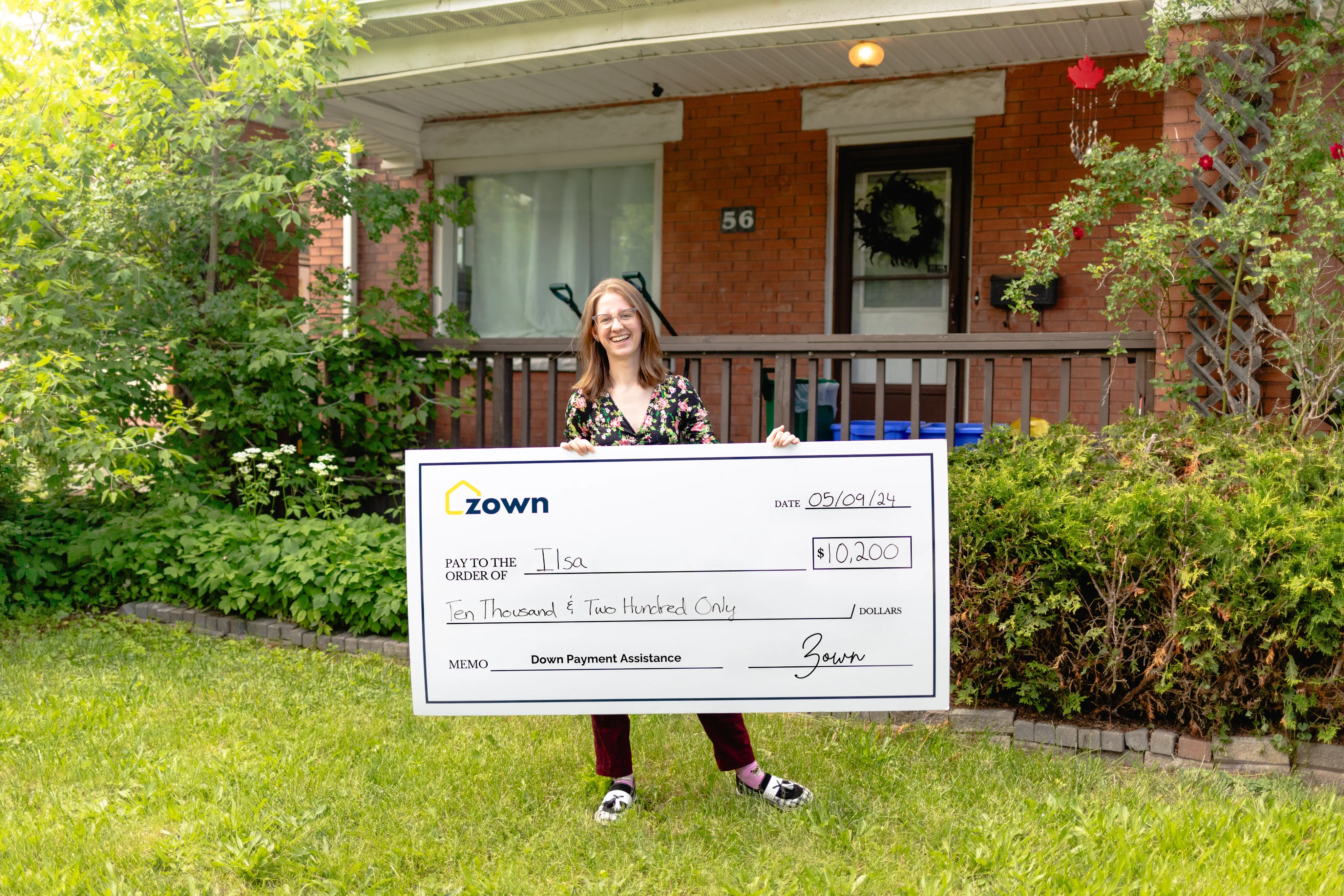
Zown's Down Payment Boost gives eligible Ontario buyers cash back of 1% of the purchase price (up to $25,000), whichever mortgage provider they use. On an $800,000 home, that is about $8,000. It's paid into your savings at closing with a Zown partner lawyer, or 2 to 8 weeks after closing with your own. Most buyers put it toward closing costs and post-closing expenses like moving and furniture, which frees up their own savings.
See our guides on the minimum down payment in Ontario and how to choose fixed vs variable rates, both of which shape your monthly payment alongside amortization.
See what your Down Payment Boost adds up to →
Amortization is one of the biggest levers on your monthly cost, and the 30-year option now open to first-time buyers gives you real flexibility. Because Zown agents are salaried, the advice you get is not commission-driven, so you can talk through the 25 vs 30 year trade-off honestly. For a full picture of your buying costs, start with our guide for the first-time home buyer in Ontario.
Last updated July 27, 2026. General information, not legal or financial advice.