In Ontario in 2026, the minimum down payment is tiered by price: 5% on the first $500,000, 10% on the portion from $500,000 to $1,500,000, and 20% on any amount above $1,500,000. So a $500,000 home needs $25,000 down, an $800,000 home needs $55,000, and a $1,200,000 home needs $95,000. Below is the full math, worked out.
What is the minimum down payment in Ontario?
The rules are set nationally and apply across Ontario. You do not put one flat percentage on the whole price. Instead, the price is split into bands, and each band has its own rate.
- 5% on the first $500,000 of the purchase price
- 10% on the portion between $500,000 and $1,500,000
- 20% on any portion above $1,500,000
The 5% band is the floor. There is no legal way to buy a home in Ontario with less than 5% down. Homes priced $1,500,000 and above require at least 20% down on the whole price, because default insurance is not available at that level (more on that below).
the minimum down payment on an $800,000 home in Ontario
How the tiered math works (worked examples)
The easiest way to see it is to run three common price points. Notice the minimum climbs faster than the price once you cross $500,000, because the second band is taxed at 10% instead of 5%.
$500,000 home
The whole price sits inside the first band, so it is a flat 5%.
- 5% of $500,000 = $25,000
$800,000 home
Split it into two bands: the first $500,000, then the remaining $300,000.
- 5% of $500,000 = $25,000
- 10% of $300,000 = $30,000
- Minimum down payment = $55,000
$1,200,000 home
Same split, just a bigger second band ($700,000 of it).
- 5% of $500,000 = $25,000
- 10% of $700,000 = $70,000
- Minimum down payment = $95,000
Minimum down payment by home price (Ontario, 2026)
- $500,000. Minimum down payment: $25,000
- $800,000. Minimum down payment: $55,000
- $1,000,000. Minimum down payment: $75,000
- $1,200,000. Minimum down payment: $95,000
- $1,500,000. Minimum down payment: $125,000
- $1,600,000 (20% floor). Minimum down payment: $320,000
Source: Zown Realty, Ontario 2026
Once you reach $1,500,000, the 20% rule takes over on the entire price, which is why the jump between $1.5M and $1.6M is so steep.
Why is 5% the floor?
Lenders want you to have real money in the home from day one. A down payment below 5% is not permitted for an insured mortgage, so 5% is the practical and legal minimum for most buyers.
Putting less down is not the same as putting nothing down. Even at 5%, you still need to cover closing costs (land transfer tax, legal fees, title insurance, and adjustments) on top of the down payment. Budget for those separately so the 5% figure does not surprise you at the finish line. For a fuller picture of the myth that you always need a big down payment, see do I need 20% down.
Do I need mortgage default insurance?
If your down payment is less than 20% of the price, you will need mortgage default insurance (the CMHC-style coverage). It protects the lender if you default, and it is mandatory on these lower-down-payment mortgages.
A few things to know:
- The premium is calculated as a percentage of your mortgage and added to the loan, so you pay it off over time rather than up front.
- The less you put down, the higher the premium rate, because the lender is carrying more risk.
- It is not available on homes priced $1,500,000 or more, which is why those homes require 20% down.
Putting down 20% or more lets you skip the insurance entirely, but it is not required to buy. Many first-time buyers in Ontario buy with less than 20% and simply carry the premium inside their mortgage.
How does the Down Payment Boost fit in?
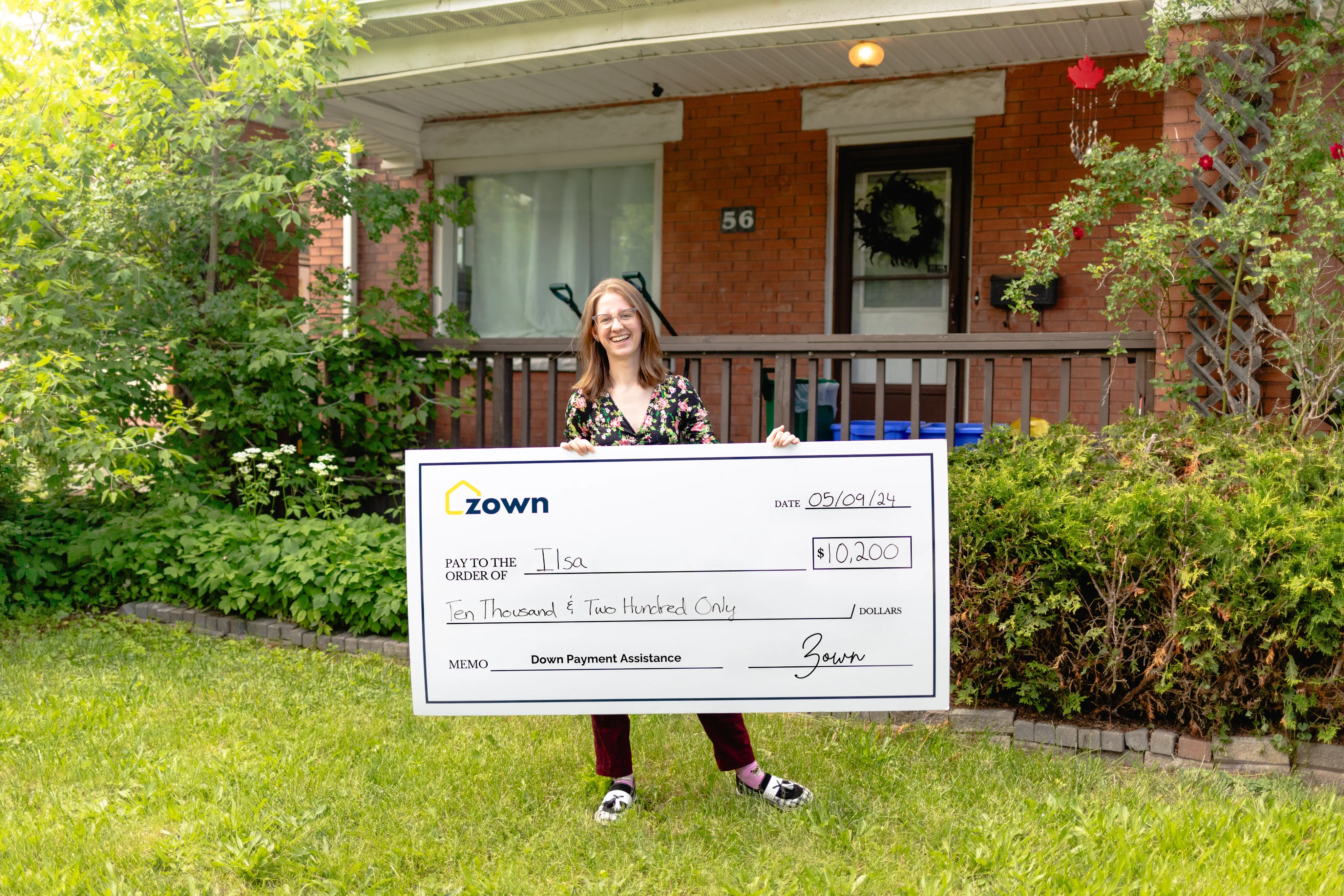
Zown's Down Payment Boost is cash back of up to 1% of the purchase price, to a maximum of $25,000, paid to you at closing. On an $800,000 home, that is roughly $8,000.
Here is the important part: the Boost is paid into your savings at closing, not added to your down payment. It does not change the tiered minimum above. What it does is lower the total cash you need to walk away with a home, because most buyers put it toward closing costs and post-closing expenses (think land transfer tax, legal fees, or furnishing the place). In Ontario, a commission rebate or cashback to the buyer is permitted when it is disclosed, and Zown discloses it clearly.
Zown is a registered brokerage (Zown Realty Inc., Brokerage) and its agents are salaried, so the advice you get is not driven by commission. You still get end-to-end guided buying, just without the pressure. For more on programs that reduce your upfront cash, see down payment assistance in Ontario.
What government programs help with the down payment?
You can stack a few tax-advantaged accounts to build the down payment faster. These are federal and provincial programs, not lender products, so they work alongside your mortgage.
- FHSA (First Home Savings Account): contribute up to $8,000 per year, $40,000 lifetime. Contributions are tax-deductible and withdrawals for a first home are tax-free.
- RRSP Home Buyers' Plan (HBP): withdraw up to $60,000 from your RRSP, repaid over 15 years. It stacks with the FHSA.
- Land transfer tax rebate: first-time buyers can claim up to $4,000 in Ontario, plus up to $4,475 on the City of Toronto municipal land transfer tax, for up to $8,475 in Toronto.
If you are just getting started, our first-time home buyer in Ontario guide walks through how these pieces fit together step by step.
See what your Down Payment Boost adds up to →
Last updated July 21, 2026. General information, not legal or financial advice.