
To get pre-approved for a mortgage in Ontario, pick a lender or broker, share your income, debts, and down payment details, then submit supporting documents (ID, pay stubs, your latest notice of assessment, and proof of your down payment). The lender reviews your file and gives you a written pre-approval with a rate hold, usually good for 90 to 120 days. Here is how the whole process works.
What is a mortgage pre-approval?
A pre-approval is a lender's written estimate of how much they are willing to lend you and at what rate, based on a real review of your finances. It is not a loose guess and it is not the final loan. It is a lender looking at your actual numbers and telling you where you stand before you start shopping.
The key benefit is the rate hold. Once you are pre-approved, the lender locks a rate for you for a set window, so a rate increase during your search does not push the home out of reach.
A pre-approval is stronger than a quick online estimate because the lender has reviewed documents, not just numbers you typed into a form. For the difference between the two, see pre-approval vs pre-qualification.
how long a mortgage pre-approval and its rate hold typically last in Ontario
How do I get pre-approved for a mortgage? (step by step)
The process usually takes a few days once your documents are ready. Here is the order it happens in.
- Choose a lender or broker. You can go to a bank directly or use a mortgage broker who shops several lenders for you. Either way, you are asking for a pre-approval, not just a rate quote.
- Share your financial picture. You will tell them your income, employment, existing debts (car loans, lines of credit, credit cards, student loans), and how much down payment you have saved.
- Submit your documents. The lender confirms what you told them against paperwork. The checklist below covers what to have ready.
- Let them run your credit. The lender pulls your credit report to check your history and score. This is a normal part of the process.
- Get it in writing. You receive a pre-approval letter stating your approved amount, the held rate, and the expiry date. Keep it handy when you make an offer.
A pre-approval tells you a ceiling, not a target. Just because a lender will lend you a certain amount does not mean your monthly budget should stretch that far. Leave room for closing costs, property tax, and the everyday cost of running a home.
What documents do I need to get pre-approved?
This is the part worth saving. Having these ready before you apply is what turns a slow pre-approval into a fast one. Lenders want to verify three things: who you are, that your income is real and steady, and that your down payment is genuinely yours.
Mortgage pre-approval document checklist (Ontario)
- Government photo ID. What it proves: Your identity
- Recent pay stubs (usually last 2). What it proves: Current income and employer
- Letter of employment. What it proves: Job, salary, and status (permanent or contract)
- T4s or notices of assessment. What it proves: Income history, often the last 2 years
- Notice of assessment (most recent). What it proves: Taxes are filed and up to date
- Proof of down payment. What it proves: Savings, FHSA, RRSP, or a gift letter
- List of debts and assets. What it proves: Your car loans, cards, and other balances
- Bank statements (recent). What it proves: Savings history, not just a one-time deposit
Source: Zown Realty, Ontario 2026
If you are self-employed, expect the lender to ask for more: two years of notices of assessment, business financial statements, and sometimes proof the business is active. It is not a red flag, just a fuller paper trail.
For the down payment specifically, lenders look for a savings history, not a lump sum that appeared last week. If part of your down payment is a gift from family, you will usually need a signed gift letter confirming it does not have to be repaid.
Why does pre-approval make my offer stronger?
In a competitive Ontario market, a pre-approval signals to the seller that you are a serious, ready buyer, not someone who still has to find out whether the financing exists. When two similar offers land on the same home, the one backed by a pre-approval is easier for the seller to trust.
It also protects you. Knowing your approved amount and your held rate before you shop means you make offers you can actually close on. That matters, because your offer on the Agreement of Purchase and Sale (OREA Form 100) is a binding commitment once accepted.
Pre-approval is not the same as a firm approval on a specific home, though. The lender still has to approve the actual property once you are under contract, including its appraised value. So keep any financing condition in your offer unless your agent advises otherwise.
How long does a pre-approval last?
A pre-approval and its rate hold typically last 90 to 120 days, depending on the lender. If you have not bought a home by the time it expires, you can usually renew it by refreshing your documents.
The rate hold works in your favour. If rates rise during your window, you keep the lower held rate. If rates fall, many lenders will honour the lower rate instead, though this varies, so ask your lender how their hold works.
Do not treat the clock as pressure to overspend. If your window runs out, renewing is routine. It is far better to renew than to rush into the wrong home.
What can break a pre-approval before closing?
This is the part buyers underestimate. A pre-approval is based on your finances as they were the day it was issued. The lender re-checks your file before closing, and if the picture has changed, the financing can shrink or fall through. The most common culprits:
- Taking on new debt. A new car loan, a new credit card, or a bigger line of credit changes your debt ratios and can lower what you are approved for.
- A job change. Switching employers, going from salaried to contract, or dropping to part-time can all trigger a fresh review. If a change is coming, tell your lender before you sign anything.
- Large purchases on credit. Financing furniture or appliances before closing is a classic mistake. Wait until after you have the keys.
- Missed payments or a credit score drop. Late payments between pre-approval and closing can hurt the file.
- Moving your down payment around. Large unexplained transfers or a shrinking balance can force the lender to re-verify the funds.
The simple rule: between pre-approval and closing, keep your financial life boring. No new debt, no job moves, no big-ticket credit purchases. If something unavoidable comes up, call your lender first.
How does Zown help first-time buyers here?
Zown is a registered brokerage (Zown Realty Inc., Brokerage) and its agents are salaried, so the guidance you get is not driven by commission. That means straight answers about what you can comfortably afford, not a push toward the top of your pre-approval.
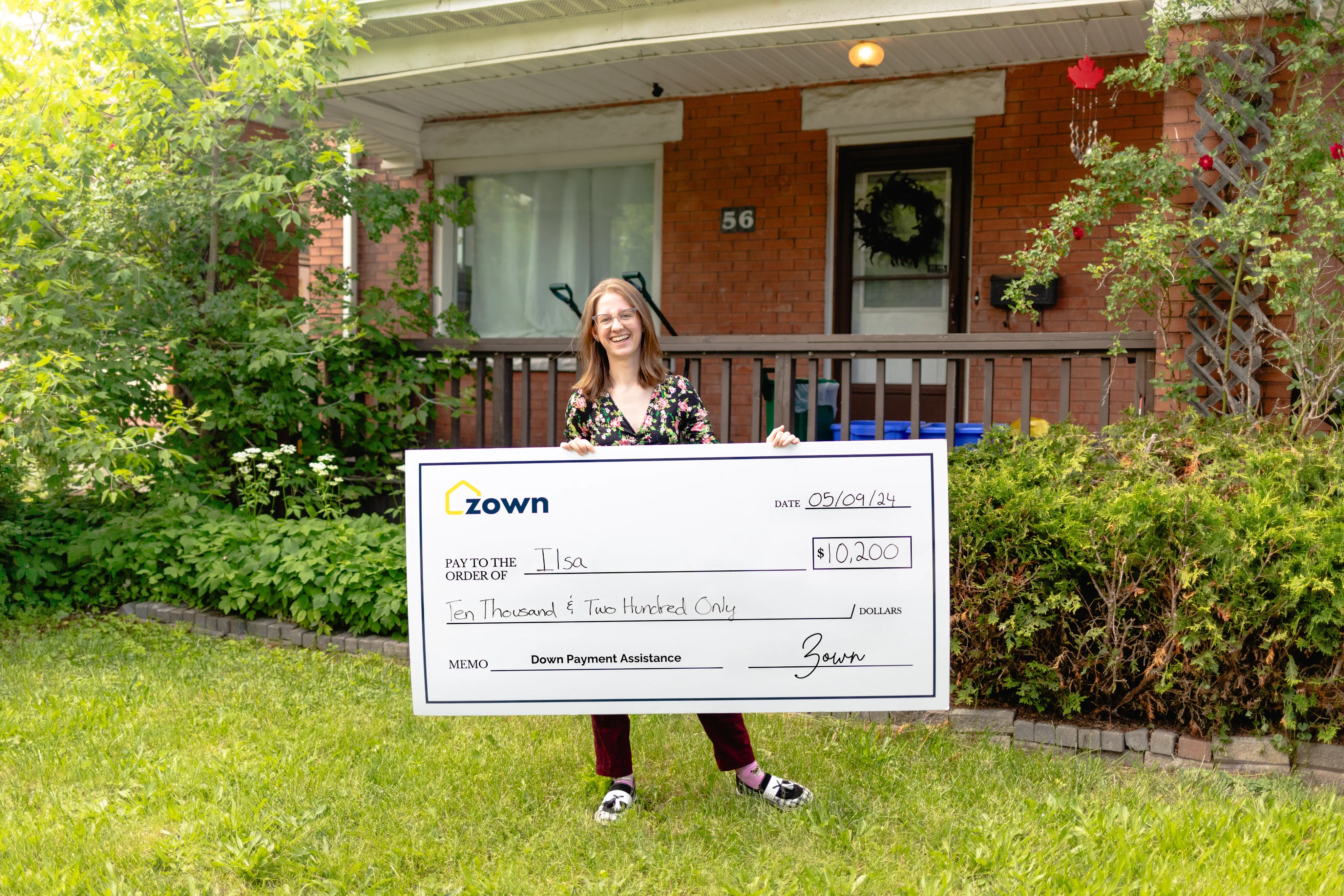
On the money side, Zown's Down Payment Boost is cash back of up to 1% of the purchase price, to a maximum of $25,000, paid to you at closing. On an $800,000 home that is roughly $8,000. It is paid into your savings at closing, so most buyers put it toward closing costs and post-closing expenses. It does not change your minimum down payment, but it lowers the total cash you need at the finish line.
If you are early in the journey, our first-time home buyer in Ontario guide maps out the full path, and minimum down payment in Ontario shows exactly how much you need up front.
See what your Down Payment Boost adds up to →
Last updated July 21, 2026. General information, not legal or financial advice.