
A bidding war in Ontario happens when several buyers make offers on the same home, often on a set "offer night." Most are blind: you cannot see what anyone else offered, so you are bidding against people you cannot see. The way to win without overpaying is to prepare early, set a firm walk-away number, and stick to it.
Below is how the process actually works, why sellers lean toward clean offers, and what an extra $50,000 over asking really costs you.
What is a bidding war and how does "offer night" work?
When a home draws a lot of interest, the seller's agent may hold offers until a specific date and time. This is offer night. Every interested buyer submits an offer by that deadline, and the seller reviews them all at once.
The seller then picks the offer they like best. That is usually the highest price, but not always. Price, conditions, deposit size, and closing date all matter.
In Ontario, offers are made on the Agreement of Purchase and Sale (OREA Form 100). A deposit, often around 5% of the price, goes with an accepted offer by certified cheque or bank draft. It is held in trust and credited toward your down payment at closing.
Can I see the other offers?
No. Ontario bidding wars are almost always blind. You do not get to see how many other offers exist or what they are worth. The seller's agent may tell you how many offers are registered, but not the dollar figures.
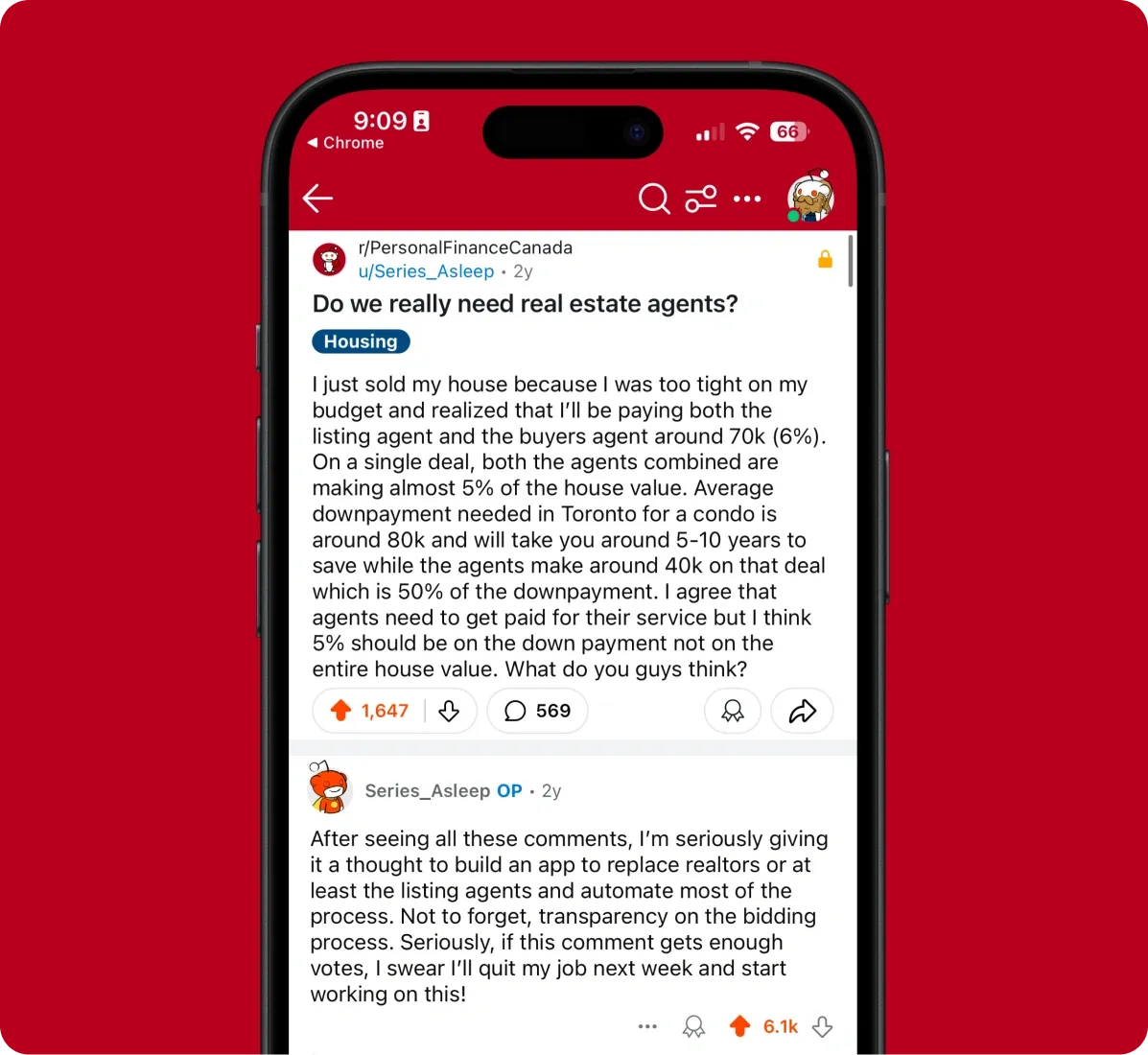
This is the hard part. Because you cannot see the competition, it is easy to panic and bid far above what the home is worth to you. Blind bidding is exactly why a firm walk-away number matters so much.
the number of competing offer amounts you can actually see in a blind Ontario bidding war
Why do sellers prefer firm offers with no conditions?
A firm offer has no conditions attached. It is not tied to financing approval, a home inspection, or the sale of your current home. Once accepted, it is binding.
Sellers love firm offers because they are certain. A conditional offer can fall apart if your financing does not come through or an inspection turns up a problem. A firm offer will not.
That certainty is why a firm offer can beat a higher conditional one. If you want to compete, you often need to remove conditions, and that only works if you have done the homework in advance. Removing conditions blindly is risky. Removing them because you already checked everything is smart.
How do I prepare for a bidding war in Ontario?
Preparation is what lets you compete without gambling. The buyers who win clean, sensible bids are the ones who did the work before offer night, not during it.
Get your financing sorted early. Have your mortgage approval in hand before you start seriously bidding, so you know exactly what a lender will give you. This is what makes it safe to consider dropping a financing condition. Do not guess. Know your real number.
Review the status certificate early (for condos). If the home is a condo, the status certificate tells you about the building's finances, reserve fund, rules, and any legal issues. Ask for it and read it before offer night so you are not waiving a condition on something you never checked.
Do inspections up front where possible. Some sellers offer a pre-listing home inspection, or allow inspections before offer night. Reviewing that in advance lets you make a firm offer without flying blind on the home's condition.
Know your true walk-away number. This is the single most important step. Decide the maximum you will pay, in a calm moment, based on your budget and your mortgage approval. Write it down. On offer night, emotions run high and it is easy to talk yourself up by "just" another $10,000, then another. A number you set in advance protects you from yourself.
For a deeper look at the mechanics of submitting an offer, see our guide on how to make an offer in Ontario.
What does going over asking really cost?
Here is the part buyers underestimate. Going over asking is not a one-time hit. You borrow most of that extra amount, and you pay it back with interest for decades.
The list price is often set low on purpose to attract multiple offers, so "over asking" can be misleading. What matters is not how far over the list price you go. It is whether the total price fits your budget and your walk-away number.
Every dollar over asking is a dollar you either add to your down payment or borrow. Borrowed dollars come with interest for the full life of the mortgage. A bigger price can also push up your land transfer tax and, if it moves you into a higher price bracket, your minimum down payment.
The table below shows illustrative math on paying an extra $50,000 over asking. These figures are examples to show the shape of the cost, not a quote. Your actual numbers depend on your rate, amortization, and down payment.
What an extra $50,000 over asking can cost (illustrative only)
- Extra cash if you paid the $50,000 upfront. Roughly: $50,000
- Extra added to a 25-year mortgage instead. Roughly: about $250 to $300 per month
- Extra interest over the life of that mortgage. Roughly: tens of thousands of dollars
- Effect on land transfer tax. Roughly: higher, since LTT rises with price
Source: Zown Realty, illustrative example, Ontario 2026
The point is simple. An amount that feels small on offer night, spread over 25 years of payments, becomes a large number. That is why your walk-away figure should be based on what you can comfortably carry every month, not on the adrenaline of the moment.
If you are still working out how much you need up front, our explainer on whether you really need 20% down breaks down the minimums.
How Zown helps you compete without overpaying
Because Zown agents are salaried, their advice is not commission-driven. They are not nudging you to bid higher just to close a bigger deal faster. Their job is to help you win the right home at the right number, and to tell you honestly when to walk away.
Zown also offers a Down Payment Boost: cash back of 1% of the purchase price, to a maximum of $25,000, paid into your savings at closing. On an $800,000 home that is about $8,000. Most buyers use it for closing costs and the expenses that come right after moving in. It does not change your offer or your bidding strategy, but it does put real money back in your pocket at the finish line.
Knowing that money is coming can also help you keep a clear head on offer night, since you are not stretching to cover every last closing cost on your own.
If you are early in the process, our first-time home buyer guide for Ontario walks through the full path from saving to closing.
See what your Down Payment Boost adds up to →
Reviewed by Arjun Dhawan, Head of Account Management and REALTOR® at Zown Realty Inc. Last updated July 16, 2026. General information, not legal or financial advice.