

The first step to buying a house is not house hunting. It is knowing your numbers: how much you can actually afford each month, how your savings compare to the down payment you will need, and what a lender will pre-approve you for. Get those three things straight first, then start viewing homes. Buyers who do it the other way around tend to get hurt.
What is the real first step to buying a house?
The real first step is figuring out what you can afford, on paper, before you fall for anything. That means three numbers: a monthly budget you can live with, a savings target for the down payment and closing costs, and a mortgage pre-approval that tells you your ceiling.
House hunting feels like the exciting first move, so most people start there. It is actually the last step of the setup, not the first. Looking at homes you have not confirmed you can buy is how good weekends turn into disappointment.
Why do buyers who start with listings get hurt?
When you start with listings, you shop with your heart instead of your numbers. You end up emotionally attached to a home before you know whether it fits your budget, and that leads to three common problems.
- You waste weekends viewing homes above your real price range, then everything in range feels like a step down.
- You find "the one," rush to a lender, and discover you are approved for less than the asking price.
- You stretch to win it anyway, then feel the strain every month after you move in.
Starting with your numbers flips this. You walk into every showing already knowing it fits, so you can move fast and with confidence when the right home appears.
The ordered first steps to buying a house
Here is the sequence that actually works. Do them in order. Each step makes the next one easier.
The first steps to buying a house, in order
- 1. Set your budget. What you do: Decide the monthly payment you can comfortably carry, including property tax, insurance, and maintenance; Why it comes first: Everything else is built on this number
- 2. Check your savings vs. the down payment. What you do: Compare what you have saved to the minimum down payment plus closing costs; Why it comes first: Tells you if you are ready now or need a few more months
- 3. Get pre-approved. What you do: Have a lender confirm your rate and the maximum mortgage you can get; Why it comes first: Turns your budget into a real, lender-backed ceiling
- 4. Start viewing homes. What you do: Book showings only within your confirmed range; Why it comes first: Now every home you see is one you could actually buy
Source: Zown Realty, Ontario 2026
Step 1: Figure out your budget
Start with the monthly payment you can carry without stress, not the maximum a calculator spits out. Factor in property taxes, home insurance, condo fees if any, utilities, and a cushion for maintenance. A home you can afford in month one but not month ten is not affordable.
Step 2: Check your savings against the down payment you need
Next, line up your savings against what you will actually need at closing. In Ontario, the minimum down payment is 5% on the first $500,000, 10% on the portion from $500,000 to $1,500,000, and 20% above $1,500,000.
the minimum down payment on an $800,000 home in Ontario ($25,000 on the first $500,000 plus $30,000 on the next $300,000)
Remember that the down payment is not your only up-front cost. You also need closing costs: land transfer tax, legal fees, title insurance, and moving expenses. First-time buyers in Ontario can claim a land transfer tax rebate of up to $4,000 provincially, and up to $4,475 more on the City of Toronto municipal tax, for as much as $8,475 in Toronto.
Two accounts make saving faster. The FHSA lets you contribute up to $8,000 a year ($40,000 lifetime), tax-deductible and tax-free for a first home. The RRSP Home Buyers' Plan lets you withdraw up to $60,000, repaid over 15 years, and it stacks with the FHSA. Our guide to being a first-time home buyer in Ontario walks through both, and the minimum down payment in Ontario breakdown shows the math for other price points.
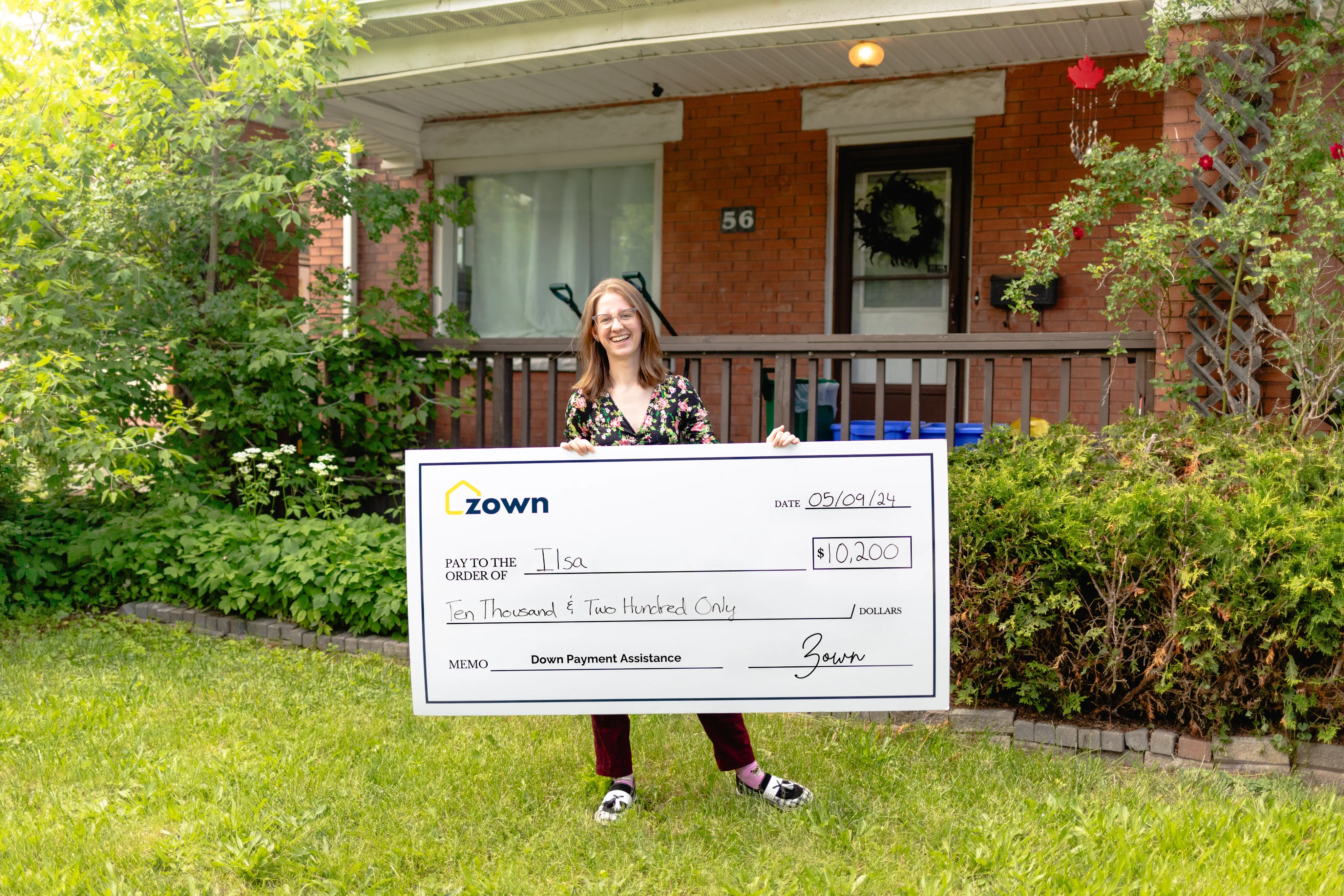
If your savings fall a little short, that gap is exactly where a Down Payment Boost can help. With Zown, you get cash back of 1% of the purchase price, to a maximum of $25,000, paid into your savings at closing. On an $800,000 home that is about $8,000 toward your closing costs and the expenses that come right after you move in.
Step 3: Get pre-approved
A mortgage pre-approval is a lender's confirmation of the rate they will hold for you and the maximum mortgage you can get, based on your income, debts, and credit. It is the difference between guessing what you can afford and knowing.
Pre-approval is not the same as pre-qualification, and the distinction matters when you make an offer. A pre-qualification is a quick estimate; a pre-approval is a firmer, verified commitment. We cover the difference in detail in pre-approval vs. pre-qualification. For most buyers, a real pre-approval is the number you should shop against.
Note that with less than 20% down, mortgage default insurance is required. The premium is added to your mortgage, and it is not available on homes priced at $1,500,000 or more.
Step 4: Now start viewing homes
Only after the first three steps should you open the listings for real. Now you have a monthly budget, a savings plan, and a lender-backed ceiling. Every showing you book is a home you could actually buy, and when the right one appears you can move quickly instead of scrambling to catch up on paperwork.
How long do the first steps take?
Setting your budget can take an afternoon. Checking your savings against your down payment target is quick once you know the numbers above. Pre-approval usually takes a few days to a week or so, depending on how fast you gather documents like proof of income and a record of your savings.
The point is that this setup is short compared to the months of house hunting ahead. A little time up front saves you from the most expensive mistakes later.
Where does a Zown agent fit in?
A good agent helps with all four steps, not just the showings. Because Zown agents are salaried rather than paid on commission, their advice is not driven by pushing you toward a bigger purchase. That is the trust edge: honest guidance from your first budgeting conversation through closing day.
That end-to-end, guided approach is why 800+ buyers have used a Zown Down Payment Boost, with $7M+ given back so far, alongside a 4.8 Google rating from 500+ reviews.
See what your Down Payment Boost adds up to →
Reviewed by Arjun Dhawan, Head of Account Management and REALTOR® at Zown Realty Inc. Last updated July 16, 2026. General information, not legal or financial advice.