
Buying your first home in Ontario usually takes about six months from the day you get serious to the day you get the keys. The first few months are about money and pre-approval. The middle months are about choosing an agent and viewing homes. The last stretch (offer, conditions, closing) can move fast. Here is the month-by-month timeline.
Every buyer moves at their own pace. Some find the right home in weeks; others look for a year. Use this as a map, not a deadline.
What does a home buying timeline look like in Ontario?
Think of it in five phases: build your budget and get pre-approved (about six months out), pick your agent and start viewing (three to four months out), make offers and negotiate (the offer stage), clear conditions and finalize financing (after acceptance), and close (keys). Each phase has a clear job to do.
The Ontario home buying timeline at a glance
- Build budget and savings. What you do: Set a budget, grow your down payment, get pre-approved; Timeframe: About 6 months out
- Choose agent and view. What you do: Pick your agent, research neighbourhoods, tour homes; Timeframe: 3 to 4 months out
- Offer stage. What you do: Make offers, negotiate, go firm; Timeframe: When you find the one
- After acceptance. What you do: Conditions, lawyer, mortgage finalized, insurance; Timeframe: 1 to 3 weeks after
- Closing. What you do: Final walkthrough, get keys; Timeframe: Closing day
Source: Zown Realty, Ontario 2026
Six months out: build your budget and get pre-approved
This is the foundation. Figure out what you can afford, keep saving, and get a mortgage pre-approval so you shop with real numbers.
Set your budget and grow your down payment
In Ontario the minimum down payment is 5% on the first $500,000, 10% on the portion from $500,000 to $1,500,000, and 20% above $1,500,000. On an $800,000 home that works out to $25,000 plus $30,000, or $55,000 minimum. With less than 20% down you will also pay mortgage default insurance, added to your mortgage.
Two accounts help first-time buyers save faster. The FHSA lets you contribute up to $8,000 a year (up to $40,000 lifetime), tax-deductible and tax-free for a first home. The RRSP Home Buyers' Plan lets you withdraw up to $60,000, repaid over 15 years, and it stacks with the FHSA.
the minimum down payment on an $800,000 home in Ontario
Get pre-approved
A mortgage pre-approval tells you how much a lender will likely lend and locks a rate for a set window. It makes your offers stronger because sellers know your financing is real. Have your income documents, savings statements, and a sense of your debts ready. For a fuller walkthrough of the early steps, see our guide to buying your first home in Ontario.
Three to four months out: choose your agent and start viewing
Now you turn budget into a search.
Pick your agent
Your agent shapes the whole experience, so choose carefully. At Zown, agents are salaried rather than commission-driven, so the advice you get is about the right home for you, not a bigger paycheque. A good agent sets up your search, explains local pricing, and guides you through offers and closing.
Research neighbourhoods and tour homes
Start narrowing where you want to live: commute, schools, transit, price range, and how a place feels on a weekday versus a weekend. Then book viewings. Seeing homes in person quickly teaches you what your budget actually buys in each area, and what you are willing to trade off.
The offer stage: make offers, negotiate, and go firm
When you find the one, things speed up. In Ontario you make an offer using the Agreement of Purchase and Sale (OREA Form 100). Your agent helps you set a price, deposit, closing date, and any conditions.
The deposit is typically around 5%, paid by certified cheque or bank draft, held in trust, and credited to your down payment at closing. The seller may accept, reject, or counter. You go back and forth until you agree or walk away. When all conditions are met (or you make a firm offer with none), the deal is "firm." For the full mechanics, read how to make an offer in Ontario.
After acceptance: conditions, lawyer, mortgage, and insurance
An accepted offer is not the finish line. You usually have a short window (often one to two weeks) to satisfy conditions before the deal is firm.
- Financing: Turn your pre-approval into a final mortgage approval on this specific home. The lender will often order an appraisal.
- Home inspection: If you made your offer conditional on one, book it early in the window.
- Lawyer: Hire a real estate lawyer to review the paperwork, search title, and handle closing funds.
- Insurance: Arrange home insurance to be active on closing day; your lender will require proof.
This is also when the first-time buyer land transfer tax rebate matters: up to $4,000 in Ontario, plus up to $4,475 on the City of Toronto municipal tax, for up to $8,475 in Toronto.
Closing: final walkthrough and keys
In the final days you do a walkthrough to confirm the home is in the condition you agreed to. Your lawyer coordinates the money and registers the transfer, and on closing day you get the keys.
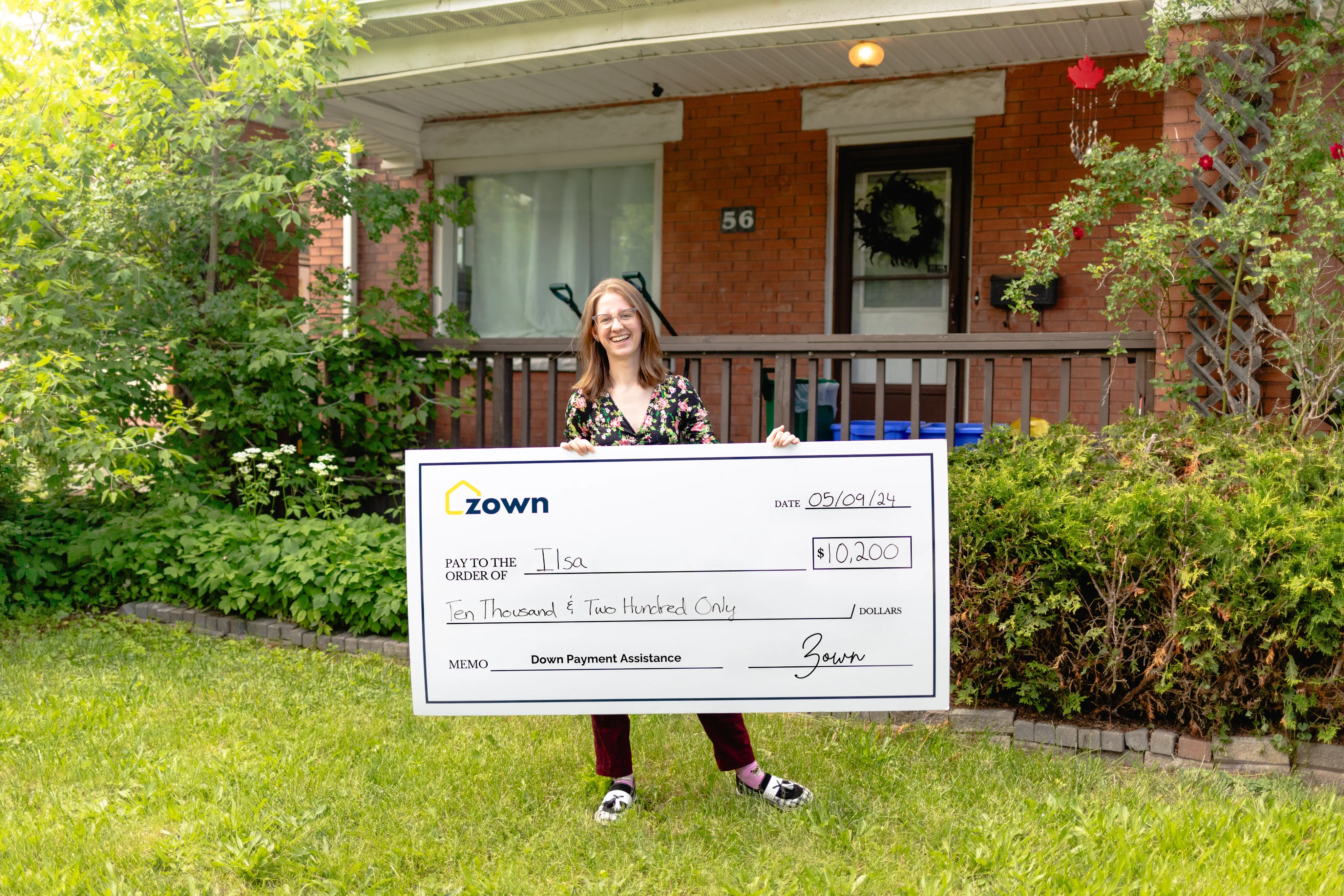
Closing costs are real and often underestimated: land transfer tax, legal fees, title insurance, and adjustments. This is where Zown's Down Payment Boost helps. It is cash back of up to 1.25% of the purchase price (maximum $25,000), paid into your savings at closing, and most buyers use it toward closing costs and post-closing expenses like furniture. On an $800,000 home that is about $10,000. Our Ontario closing process guide covers this final stretch in detail.
Frequently asked questions
How long does it take to buy a house in Ontario?
Most first-time buyers spend about six months from starting to save and getting pre-approved through to closing. The search itself varies widely. Some buyers find a home in a few weeks, others take a year. Once an offer is accepted, closing is often 30 to 90 days out, depending on the date you negotiate.
When should I get pre-approved?
Aim to get pre-approved before you start viewing homes seriously, roughly three to six months out. A pre-approval shows what a lender will likely offer, locks a rate for a set window, and makes your offers stronger. It also stops you from falling for homes outside your real budget.
How much time do I have between an accepted offer and closing?
The closing date is negotiated in the offer, so you choose it with the seller. It is commonly 30 to 90 days. Between acceptance and closing you clear any conditions (usually within a week or two), finalize your mortgage, hire a lawyer, and arrange insurance.
Can I speed up the home buying timeline?
Yes. Getting pre-approved early, saving your down payment ahead of time, and having documents ready all remove delays later. A responsive agent and lawyer keep conditions moving. The search stage is the hardest to rush, since it depends on the right home coming to market at your price.
What happens on closing day?
You typically do a final walkthrough to confirm the home matches what you agreed to. Your lawyer handles the transfer of funds and registers the property in your name. Once everything clears, you receive the keys. Your down payment and any Down Payment Boost cash back are settled through your lawyer at this stage.
When does the Down Payment Boost get paid?
The Down Payment Boost is paid at closing, into your savings, through your lawyer. It is not added to your down payment. Most buyers put it toward closing costs and early post-closing expenses. See what you get back before you start shopping.
See what your Down Payment Boost adds up to →
Reviewed by Arjun Dhawan, Head of Account Management and REALTOR® at Zown Realty Inc. Last updated July 16, 2026. General information, not legal or financial advice.


