If you are buying your first home in Ontario in 2026, there are several incentives that can put real money back in your pocket. The biggest ones are the FHSA and RRSP Home Buyers' Plan (for tax-free savings), the First-Time Home Buyers' Tax Credit ($1,500), land transfer tax rebates (up to $8,475 in Toronto), 30-year amortization on insured mortgages, and Zown's Down Payment Boost. Here is what each one is worth.
What incentives do first-time home buyers get in Ontario?
There is no single "first-time buyer program." Instead, there is a stack of separate incentives from the federal government, the Ontario government, the City of Toronto, and your brokerage. Used together, they can add up to tens of thousands of dollars.
Most of them are not automatic. You have to open the right account, claim the right credit on your tax return, or ask for the right rebate at closing. This page walks through each one and what it is worth, then points you to deeper guides.
the maximum land transfer tax rebate for a first-time buyer in the City of Toronto ($4,000 Ontario + $4,475 municipal)
The 2026 incentives at a glance
Here is every major first-time buyer incentive in Ontario and roughly what each one is worth.
First-time buyer incentives in Ontario (2026)
- FHSA (First Home Savings Account). What it is worth: Up to $8,000/year, $40,000 lifetime, tax-deductible and tax-free for a first home
- RRSP Home Buyers' Plan (HBP). What it is worth: Withdraw up to $60,000 tax-free, repaid over 15 years
- First-Time Home Buyers' Tax Credit. What it is worth: $1,500 (a non-refundable federal tax credit)
- Ontario land transfer tax rebate. What it is worth: Up to $4,000
- Toronto municipal LTT rebate. What it is worth: Up to $4,475 (Toronto homes only)
- 30-year amortization (insured mortgages). What it is worth: Lower monthly payments; available to first-time buyers on insured mortgages
- Zown Down Payment Boost. What it is worth: 1% of the price, maximum $25,000, into your savings at closing
Source: Zown Realty, Ontario 2026
How much can the FHSA and RRSP Home Buyers' Plan save me?
These two are the heavy lifters, because they let you build your down payment with money that has not been fully taxed.
The FHSA (First Home Savings Account) lets you contribute up to $8,000 per year, to a $40,000 lifetime maximum. Contributions are tax-deductible like an RRSP, and withdrawals for a first home are tax-free like a TFSA. It is one of the most valuable accounts available to a first-time buyer. Our full FHSA guide breaks down the rules and timing.
The RRSP Home Buyers' Plan (HBP) lets you withdraw up to $60,000 from your RRSP tax-free to put toward a first home. You repay it to your RRSP over 15 years. It stacks with the FHSA, so a couple who each use both accounts can pull together a substantial down payment. See our RRSP Home Buyers' Plan guide for the repayment details.
Together, one person could combine up to $40,000 from an FHSA and up to $60,000 from the HBP. Two buyers can double that.
What is the First-Time Home Buyers' Tax Credit worth?
The First-Time Home Buyers' Tax Credit is a federal, non-refundable tax credit worth $1,500. You claim it on your income tax return for the year you buy, as long as you and the home meet the first-time and eligibility rules.
It will not help you at closing, but it is money back the following tax season. It is easy to miss, so put a note in your file to claim it.
How do the land transfer tax rebates work?
Land transfer tax (LTT) is one of the larger closing costs in Ontario, and first-time buyers get rebates that soften the hit.
- Ontario rebate: up to $4,000 off the provincial land transfer tax.
- City of Toronto rebate: up to $4,475 off the separate municipal land transfer tax, which only applies to homes inside Toronto.
If you buy in Toronto as a first-time buyer, you can claim both, for up to $8,475 in total rebates. Outside Toronto, only the provincial $4,000 rebate applies, since there is no municipal LTT. Your lawyer usually applies the rebate at closing so you pay less up front.
What does 30-year amortization do for first-time buyers?
For first-time buyers with an insured mortgage (less than 20% down), a 30-year amortization option can lower your monthly payment by spreading the loan over a longer period. A lower monthly payment can make it easier to carry the home month to month.
Keep in mind the trade-off: a longer amortization means you pay more interest over the full life of the mortgage. It is a cash-flow tool, not free money. Talk it through with your mortgage advisor to see if it fits your numbers.
Also remember that with less than 20% down, mortgage default insurance is required. The premium is added to your mortgage, and this insurance is not available on homes priced $1,500,000 or more.
How much is Zown's Down Payment Boost?
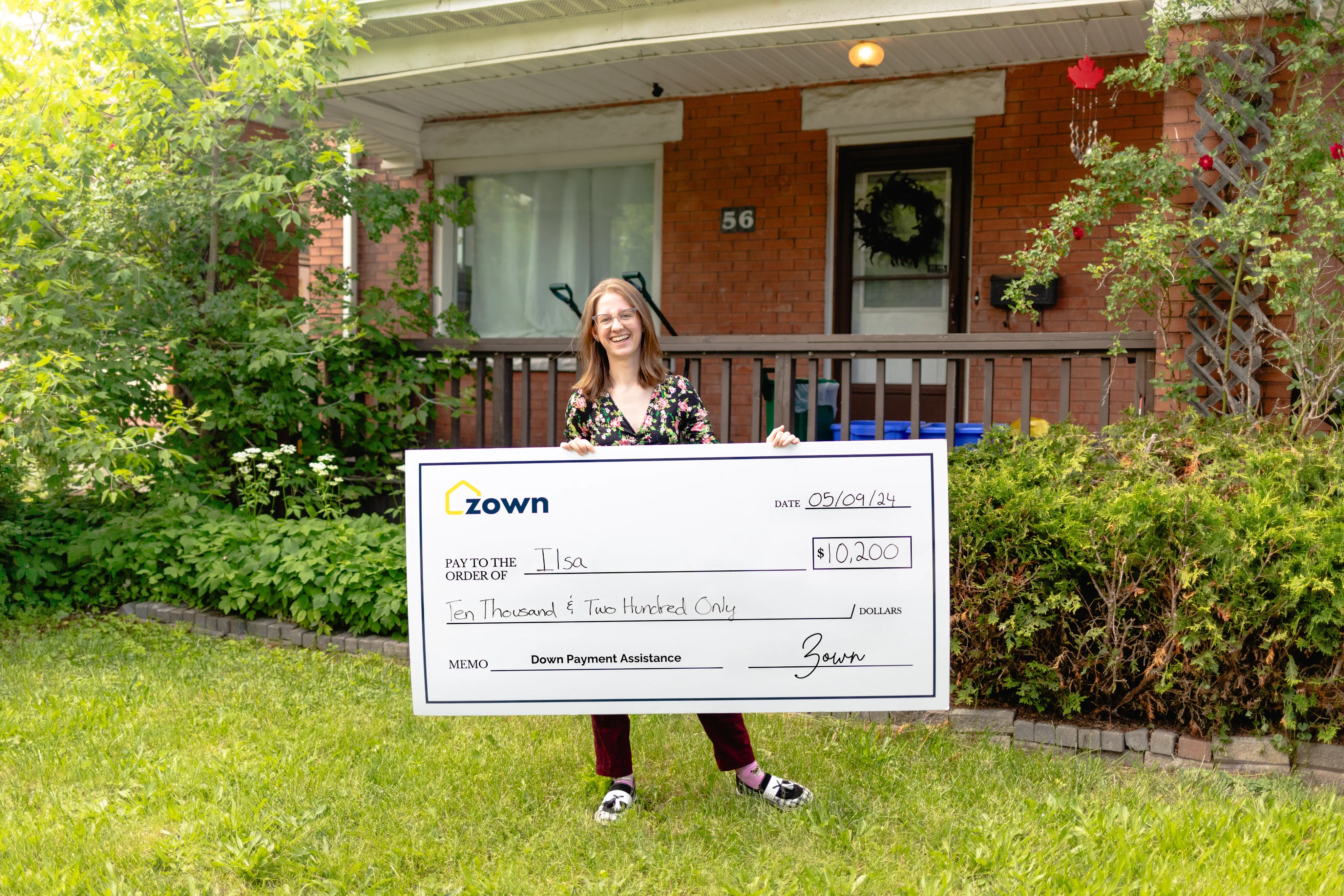
Zown's Down Payment Boost is cash back of up to 1% of the purchase price, to a maximum of $25,000, paid to you at closing. On an $800,000 home, that is roughly $8,000.
Here is the important part: the Boost goes into your savings at closing, not into your down payment. Most buyers use it for closing costs (like land transfer tax and legal fees) and for the expenses that come right after you move in, such as furniture and small repairs.
It works because Zown is a registered brokerage (Zown Realty Inc., Brokerage) and a cashback to the buyer is permitted in Ontario when it is disclosed. Zown agents are salaried, so their advice is not driven by commission. That means the cashback is the hook, but the real edge is unbiased, end-to-end guidance through your first purchase. If you want a broader look at buyer support in the province, see our guide to down payment assistance in Ontario.
How do I put all of this together?
Start early, because the savings accounts (FHSA and HBP) need time to fund. Then map the one-time items (tax credit, LTT rebates, Down Payment Boost) so nothing gets left on the table at closing.
Remember the Ontario minimum down payment: 5% on the first $500,000, 10% on the portion from $500,000 to $1,500,000, and 20% above $1,500,000. On an $800,000 home that is $25,000 plus $30,000, or $55,000 minimum. The incentives above help you reach that number and cover the costs around it.
For a step-by-step walkthrough of the whole journey, read our first-time home buyer guide for Ontario.
See what your Down Payment Boost adds up to →
Last updated July 24, 2026. General information, not legal or financial advice.